
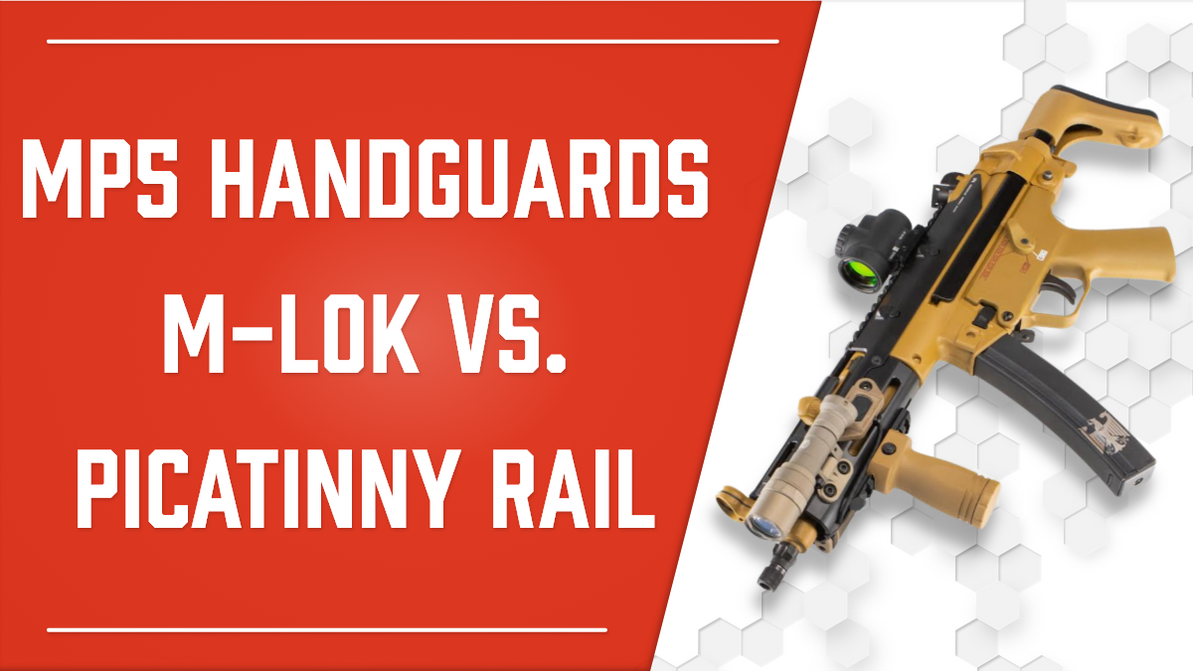
Top 5 M-LOK Handguards for Your HK MP5 Build, and Why M-LOK Beats Picatinny... or Does it?
Why Does M-LOK Take the Win?
To incorporate Picatinny mounting points in a handguard design, material must be added, creating additional weight and bulk. Conversely, adding M-LOK attachment points requires the removal of material, allowing the handguard to retain its outer dimensions while reducing weight.
- Slimmer grip diameter
- Better heat dissipation
- Lighter overall weight
Time for a Qualifying Statement
And by time, we mean high noon, 12 o’clock, right on top. Although M-LOK is, in our opinion, the superior mounting method for accessories like lights, laser pointers, and activation switches, Picatinny still retains its crown as the king of optic mounts. Handguards offering the best of both worlds abound in the firearm industry, with several great options for the MP5 as well.
Top 5 MP5 M-LOK Options
- HKP-20739 - UTG PRO HK MP5 Handguard - Extended Picatinny Mount - M-LOK - (Best of both worlds)
- HKP-17148 - HKP HK MP5, HK94, HK53, HK51 M-LOK Handguard
- HKP-21556 - MI HK MP5 M-LOK Suppressor Handguard - (Best of both worlds)
- HKP-18472 - MI HK MP5 M-LOK Forearm
- HKP-21673 - UTG PRO HK MP5 M-LOK Handguard - Extended Length - (Best of both worlds)
Advantage: M-LOK
- Picatinny rails can be added to M-LOK handguards for shooters who have both Picatinny and M-LOK accessories.
- As M-LOK continues to gain popularity, more manufacturers are adding M-LOK accessories to their catalogs to meet demand.
- Low-profile M-LOK-compatible sling QD attachments are readily available.
- Picatinny rails can easily be added to M-LOK attachment points to host legacy Picatinny accessories.
Installation Checklist
- Verify compatibility of any MP5/SP5 handguards with clones (if applicable), as they may require trimming or fitting.
- Cycle the cocking handle during test fitment. Some aftermarket cocking handles are not compatible with all handguards.
- Torque mounting hardware evenly and apply thread locker.
Accessory Combos
A Brief History of Rail Systems
The Weaver rail was one of the earliest attempts at a universal scope mount and accessory rail system, but it never had true standardization. Weaver rail spacing was inconsistent, resulting in both military and civilian HK MP5 owners relying on claw mounts or other aftermarket mounting solutions. In the 1980s, A.R.M.S. (Atlantic Research Marketing Systems) attempted to standardize the Weaver rail, but this was long before CAD files could be shared via email. Attachment compatibility problems remained for years to follow [1].
At Picatinny Arsenal in New Jersey, U.S. Army engineer Gary Houtsma developed what became MIL-STD-1913, also known as the Picatinny rail. The U.S. military officially adopted the Picatinny rail on February 3, 1995 [2][3]. Its standardized dimensions, slot width 0.206 in (5.23 mm), slot center spacing 0.394 in (10.0 mm), and slot depth 0.118 in (3.0 mm), gave shooters and manufacturers a repeatable way to mount optics, lights, grips, and lasers across rifles, carbines, and submachine guns like the HK MP5.
Due to its success, NATO refined the design into the NATO Accessory Rail (NAR) under STANAG 4694, approved in 2009 and published in 2011 [4]. The NAR was backward-compatible with MIL-STD-1913 Picatinny accessories but offered tighter tolerances for better repeatability.
The Picatinny rail was incredibly durable, but not perfect. The sharp ridges tend to chew up the operator’s hands, add weight to the platform, block airflow around the barrel, and retain heat. Shooters wanted something lighter, sleeker, and more modular.
By 2007, Magpul began experimenting with lighter “negative space” mounting slots in its MOE (Magpul Original Equipment) line. The idea wasn’t brand new, it originated from Magpul’s Masada Concept Rifle, which was later released as the Bushmaster/Remington ACR. That rifle’s handguard used the same type of slotted design, which Magpul then carried over into the MOE family [5]. This concept eventually matured into M-LOK (Modular Lock), which Magpul officially launched as an open standard in 2014 [6][7].
Most M-LOK handguards are free-floating, meaning they don’t contact the barrel. This allows optics and accessories to stay secure under recoil and heat, while the open slots reduce weight and improve barrel cooling. According to The Armory Life, M-LOK’s design not only cuts weight but also improves ergonomics. For HK enthusiasts, this means an MP5 M-LOK handguard delivers less arm fatigue and more comfort during extended use.
M-LOK vs. Picatinny in Practice
According to RifleGearLab, Picatinny rails remain one of the most rugged systems ever designed, but they come with extra weight and sharp edges that make them less comfortable for long sessions. M-LOK, by comparison, is lighter, smoother in the hand, and attaches quicker. Yes, exceptions to attachment speed exist, manufacturers offer quick attach/detach (usually cam-lock style) Picatinny mounts for accessories, but those mechanisms add weight and bulk. For many shooters, the ability to cut weight without losing durability gives M-LOK the edge, while still allowing the attachment of short Picatinny sections to M-LOK attachment points for legacy accessories when needed [8].
The Rise and Fall of KeyMod
Meanwhile, VLTOR Weapon Systems released KeyMod in 2012, with early adoption driven by Noveske Rifleworks [9]. KeyMod handguards offered a slim, self-aligning design and good recoil resistance. The downside was weaker performance with polymer accessories, which forced many shooters into bulkier, pricier mounts.
The debate between M-LOK and KeyMod came to a head in 2017, when the Naval Surface Warfare Center tested both systems for durability, static failure loads, and whether optics returned to zero after removal and reattachment. M-LOK beat KeyMod in nearly every category, especially repeatability and resistance to abuse [10][11]. After that, both the U.S. military and the commercial market moved decisively toward M-LOK.
Final Thoughts
Today, Picatinny rails remain essential for full-length optics rails and heavy-duty mounts, but M-LOK is the clear winner for modern free-float handguards. For HK rifles, carbines, and submachine guns like the MP5, an M-LOK handguard combines lighter weight, better ergonomics, and more accessory options. KeyMod still exists on some legacy builds, but with adapters that let you add short Picatinny sections to M-LOK slots, builders can enjoy the best of both worlds.
Sources
- Weaver rail – Wikipedia. Weaver rail mount
- Picatinny rail – Wikipedia. Picatinny rail
- U.S. Army. Picatinny engineer recognized for developing venerable Picatinny Rail. Army.mil
- NATO Accessory Rail (STANAG 4694) – Wikipedia. NATO Accessory Rail
- Magpul MOE / ACR development history – Wikipedia. Magpul Industries
- M-LOK – Wikipedia. M-LOK
- The Armory Life. What Is M-LOK?
- RifleGearLab. M-Lok vs Picatinny Rail System: What Is the Difference?
- KeyMod – Wikipedia. KeyMod
- McGee, T. KeyMod vs. M-LOK Modular Rail System Comparison. NSWC Crane, NDIA Symposium, 2017. NDIA PDF
- USSOCOM Selects M-LOK for Weapon Programs. Soldier Systems Daily, March 2017. Soldier Systems
Recent Posts
-
The HK91 and G3 ; A Battle Rifle Legend and How to Upgrade Yours
Few rifles have left as large a mark on military history as the Heckler & Koch G3. Known for its rug …16th Mar 2026 -

MP5 Stocks: Fixed, Retractable, Folding. Know the Differences and Which One Is Right for You
Few firearm platforms are as instantly recognizable as the MP5, and a big part of that iconic profil …10th Feb 2026 -
California Checkout Update: Shipping to California Under AB1263
What to Expect With Our New Compliance System We’ve updated our California checkout process to make …1st Feb 2026