
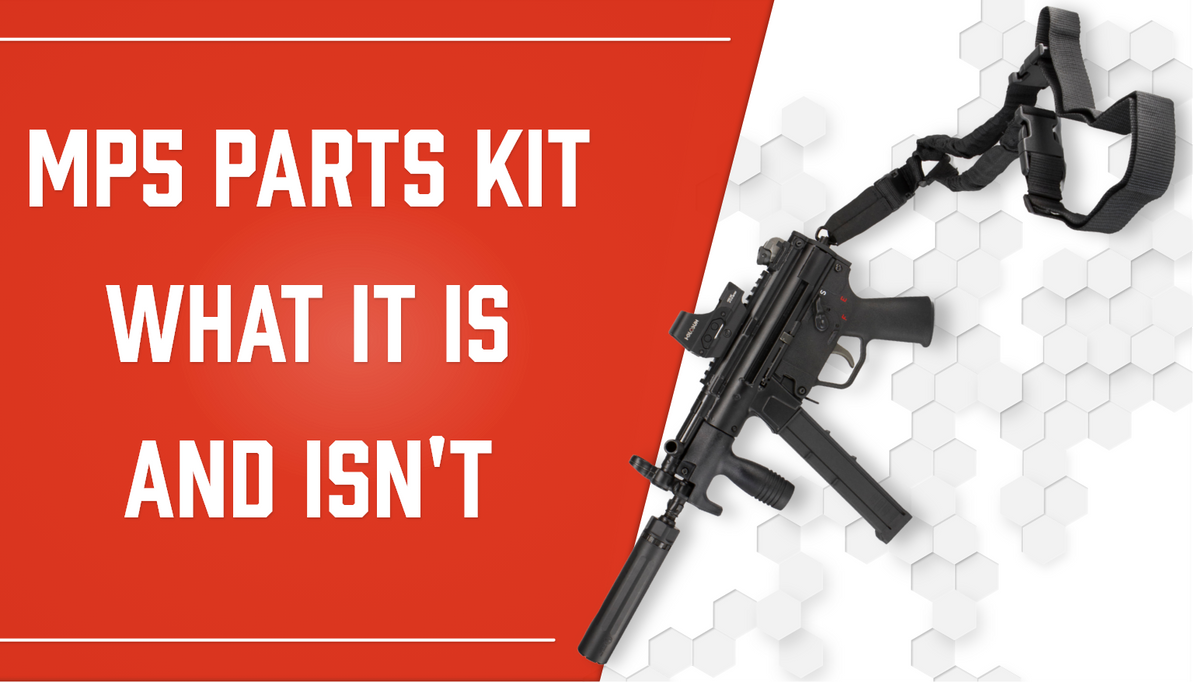
Beginner’s Guide to Understanding MP5 Parts Kits
What an MP5 Parts Kit Is (and Isn't)
An MP5 parts kit bundles key subassemblies and small parts into a single package. Purchasing a parts kit saves time and money versus sourcing components individually. Most importantly, parts kits are comprised of verified-compatible components thereby taking the guesswork out of the game. But parts kits are not firearms, because kits do not include a formed receiver. [1][2]
Parts kits offer immense flexibility, not only in overall configuration, but in selecting which parts will consist of the finished build. Some components are no longer available as new; therefore, kits may require used or reconditioned parts to be completed. If a desired kit configuration is not available on the market, the missing puzzle pieces can be sourced pre/post assembly to achieve the desire outcome. The options are endless.
Part Kit Types
De-Milled
De-milled parts kits begin life as original, factory-built, select-fire (in most cases) HK MP5s from Germany. When military and law-enforcement agencies update their arsenals, they must dispose of their MP5 fleet properly and may sell the de-milled parts kits to offset replacement costs. U.S. laws permit these genuine MP5s to be physically "destroyed" (per strict ATF guidelines), then sold as non-firearm parts kits on the commercial market. [3][7]
Because these kits were once select-fire, genuine MP5s straight from Germany, they are the most desirable foundation for an authentic build. All usable components are removed from the de-milled receiver and included in the kit, leaving the new receiver flat as the only non-original part in the mix. Receiver flats, as the name implies, are flat pieces of stamped steel that, once folded and welded, are considered the firearm. The popularity of MP5 parts kits is due to the ability to replicate HK’s own factory process with just a press, bending jig set, select tools, and some patience. For enthusiasts aspiring to the most factory-correct result, an SP5 receiver can be utilized so all components are technically factory German.
HK Parts Favorite De-Milled Kit:
HKP-00771 - H&K HK MP5 9mm German Parts Kit - A2 Stock & SEF Lower
New
New kits are comprised of entirely new parts or a mix of new, used, and reconditioned components. These kits allow the creation of rare MP5s like the MP5SD more affordably than purchasing a factory de-milled kit. New kits also open the door to configurations HK never intended such as the MP5/MP5K “reverse-stretch” hybrid or an MP5K chambered in .357 Sig. New kits are modular: the receiver flat, barrel, trunnion, trigger group, and furniture can be mixed-and-matched to achieve the exact build you want. Vendor listings typically show what is included and what is excluded, always read the inventory list closely before purchase and verify component compatibility if mixing/matching.[4]
HK Parts Favorite New Kit:
HKP-18039 - HKP HK MP5 9mm Pistol Build Kit - Flat, Top Rail, and Wedlment Set
When Does a Parts Kit Become a Firearm?
The receiver flat (the stamped steel receiver blank) is not considered a firearm and does not require ATF paperwork to purchase. The receiver flat becomes a firearm once it is “readily convertible” into a functional weapon, generally after it has been folded. PMFs (Privately Made Firearms) fall under ATF jurisdiction once they meet the regulatory definition of a frame or receiver. Always consult ATF regulations and local laws before starting a build. [1][2]
Receiver Folding
MP5-specific receiver bending jigs, forming mandrels, and other necessary tools are available to purchase or rent, including our All Steel Flat Bending Jig Set, Aluminum Flat Bending Jig Set, and Rental HK Flat Bending Jig Set. For those that don’t want to endeavor the receiver forming process, pre-folded and welded receiver flats are available as finished receivers but are legally firearms that require an FFL transfer. If a receiver is out of spec after folding, the MP5 cannot be assembled into a functional firearm without post-work. The remedy usually requires some patient massaging of the folded receiver in a bending jig rather than expensive gunsmith labor. [3][4]
What You’ll Find in a Kit (not an exhaustive list)
- Bolt group: bolt head, rollers, pins, locking piece, extractor, firing pin, carrier, recoil rod.
- Trigger group: housing, hammer, trigger, sear, springs, selector, ejector lever.
- Cocking assembly: cocking tube, support, handle, spring, roll pin.
- Sights & hardware: rear diopter drum assembly, front sight tower, sight blade, hardware.
- Misc: magazine, mag release, push pins, de-milled receiver sections (de-milled kits only).
- Furniture: handguard, end cap, stock (not included in pistol configuration kits), or brace.
Vendor inventory options vary, HK Parts and similar kit listings show typical inclusions and exclusions, so always verify the totality of components before clicking that checkout button. [4]
What’s Usually Missing
- Receiver flat and weldment set
- Barrel (most de-milled kits)
- 922(r) compliance parts (most de-milled kits)
- Specialized tools (bending jig, headspace gauges, micrometer, torque drivers, welder)
Choosing the Right Kit
- New production: highly configurable and economic.
- Surplus / de-milled: authentic factory parts; anticipate replacing wear items like springs, extractors, rollers, and other consumables.
- Push-pin (true MP5) vs semi-auto shelf like the SP5: confirm what your furniture and receiver support.
- Complete vs partial kits: verify inventory lists carefully before purchase. [4]
Compatibility Checks
- Receivers: MP5 vs SP5 HK94 vs MP5K vs SP5K vs SP89, dimensions differ, so parts are not always universally interchangeable.
- Trigger housings: ambidextrous, SEF, Navy, Contoured, and a host of aftermarket options
- Trigger packs: semi-auto vs burst vs full-auto; packs must be compatible with the housing and bolt carrier group.
Inspection on Arrival (De-Milled Kits)
Degrease and inspect critical mating surfaces, measure roller sizes, function check the trigger pack, check the extractor, and confirm sight fit. Replace obviously worn springs and pitted extractors before assembly. Inspect barrel for bulges, barrel chamber, and tri-lugs. Check trunnion for cracks and excessive wear. Inspect polymer components (grip, stock, end cap, handguard) for cracks.
922(r) compliance, does it matter to you?
18 U.S.C. §922(r) limits the number of imported parts that can be used to assemble certain semiautomatic rifles in the U.S.(does not apply to pistols). If you plan to sell or transfer the finished rifle, or want to avoid ambiguity, count the components on the 922(r) list and replace enough foreign-made parts with U.S.-made equivalents to meet compliance. Consult an FFL or firearms attorney if unsure. Industry guides and vendor compliance pages provide practical checklists. [5][6]
Assembly Sequence (Simplified)
- Fold and weld receiver (or use a pre-folded receiver)
- Weld weldment kit to receiver (semi-auto shelf block, case deflector, sight base, sling clip, stock bushing)
- Fit trunnion and barrel and check headspace (safety-critical)
- Install cocking tube support, charging handle
- Assemble bolt group and stock and set roller size to match headspace (recommended head space: 0.25mm-0.45mm)
- Assemble trigger group and function test before attaching to the receiver
- Install furniture
- Range test with standard ammo (124gr for 9mm); adjust rollers/headspace if needed
Common Beginner Mistakes
- Buying wrong kit (MP5 vs MP5K)
- Skipping roller/headspace checks
- Assuming surplus equals drop-in ready
- Not having the right tools, forcing stubborn parts, lacking the requisite mechanical aptitude
Tools You’ll Want (Basic and Helpful)
- MP5 specific receiver folding jig and hydraulic press
- Torque driver and bits
- Punch set (roll pins, taper pins)
- Micrometer for rollers
- Headspace gauges (or access to a gunsmith for final check) [8]
- Calipers, feeler gauges, bench vise with soft jaws
- Degreaser, cleaning supplies, thread locker, anti-seize, firearm-specific lubricant
Headspace and Roller Sizing, Why Size Matters
With roller-delayed blowback systems like the MP5, roller size sets the bolt gap and directly affects safe, reliable operation. Incorrect roller sizing or improper headspace can cause feeding/extraction failures, accelerated wear, and, in extreme cases, unsafe pressure behavior. An easy way to remember the size you need to order: plus-size rollers increase the bolt gap and minus-sized rollers decrease the bolt gap. If you’re not comfortable measuring headspace, consult a qualified armorer or gunsmith. Vendor and community roller guides are good references when selecting roller sizes. [8]
Range Break-In and Test Protocol (Recommended)
- Function-check the trigger pack outside the receiver
- Cycle a mag of dummy rounds by hand to verify cycling
- Initial live-fire: 5 rounds of standard-pressure ammo; weak ejection can be caused by insufficient bolt gap (under 0.25mm)
- Increase round count incrementally and between mags, check components for looseness
- If you swap rollers or locking piece, repeat the same progressive test
- Watch for “receiver dimpling”, a result of the carrier impulse being too high for the buffer. The inertia forces excessive outward pressure on the rollers thus denting the rear of the receiver outward.
- After the first session, disassemble entire firearm and thoroughly inspect for premature wear and breakage.
Troubleshooting Quick Hits
- Failure to feed: check magazine fit/mag catch, barrel seat & headspace. Aftermarket magazines and ammunition are the most common culprits.
- Failure to extract: inspect extractor/spring and bolt gap.
- Light strikes: test firing-pin and spring, hammer spring strength, and bolt gap.
- Loose sights/rails/accessories: torque evenly to the manufacturer’s spec. and use thread-locker where appropriate.
Parts and Upgrade Recommendations (De-Milled Kits)
- Start fresh with a new ejector lever spring and axle, extractor and extractor spring, hammer spring, roller spring, firing pin and spring. H&K / HKP HK SP5 Replacement Parts Kit
- New extractor & extractor spring if not included in kit. Consider upgraded extractor/spring if intending high-round use
- Quality spare pin kit
Maintenance and Longevity Tips
- Routinely replace high wear parts like ejector lever spring and axle, extractor and extractor spring, hammer spring, roller spring, firing pin and spring. H&K / HKP HK SP5 Replacement Parts Kit
- Keep bolt face and rollers properly lubricated per HK guidelines.
- Inspect rollers and locking surfaces after the first 500 and 1,000 rounds.
- Use firearm-specific cleaning/lubricating chemicals, safe for metal finishes and polymer furniture.
Pro Tip: When assembling a de-milled MP5 parts kit, always replace high wear springs and the extractor. These inexpensive upgrades improve bolt reliability, ensure consistent cycling, and extend the service life of your build.
Final Checklist Before You Close The Build
- Headspace checked and documented, 0.25-0.45mm is ideal (gunsmith sign-off if unsure) [8]
- Roller sizes matched and recorded
- All screws torqued; thread locker applied where required
- Trigger pack function-checked outside receiver
- Range-test results logged including ammo brand and grain
- 922(r) part count reviewed if you intend to sell/transfer [5]
Sources
- Definition of “Frame or Receiver” - ATF. Final Rule & summary
- Privately Made Firearms - ATF. PMFs guidance
- Are machine gun parts kits importable? - ATF. Demil Guidance
- MP5 / SP5 parts kits - HK Parts. MP5 Parts Kit Listings
- 922(r) compliance explainer - Fastbound. Industry Guidance
- Indianapolis Ordnance. 922(r) Compliance Overview
- MCT Defense. Military Surplus & Demilled Parts Kits Explanation
- Community Discussion - HKPro. Roller Size, Bolt-Gap & Headspace
Recent Posts
-
The HK91 and G3 ; A Battle Rifle Legend and How to Upgrade Yours
Few rifles have left as large a mark on military history as the Heckler & Koch G3. Known for its rug …16th Mar 2026 -

MP5 Stocks: Fixed, Retractable, Folding. Know the Differences and Which One Is Right for You
Few firearm platforms are as instantly recognizable as the MP5, and a big part of that iconic profil …10th Feb 2026 -
California Checkout Update: Shipping to California Under AB1263
What to Expect With Our New Compliance System We’ve updated our California checkout process to make …1st Feb 2026